Introduction
When it comes to guitar, exploring voicing can enhance your harmonic proficiency and musicianship, among many other skills.
Gaining a systematic voicing, voiceleading and harmonic knowledge helps not only in creating rich and interesting guitar arrangements but also in improvising, composing, comping and, of course, mastering the fretboard.
In this article, we will explore the definition of guitar voicing and how you can apply them to your playing.
What does chord voicing mean?
“Voicing refers to the way we arrange and play chord-tones on the guitar “
4 Steps to Voicing
- Selection. A chord combines 3 to a maximum of 12 notes (e.g. the grandmother chord has 12 notes). Simple triads have three notes, whereas extended chords have 7 + notes. Pianists can play extended chords easily (often jazz pianists think triad over bass structures instead of complex chords’ symbols ). On the guitar, we have a limit of six strings (unless you use a 7 or 8 string guitar), yet we can reproduce the sound of many extended chords omitting specific notes.
- Location. Awareness of something allows directed changes. Because each note on the guitar has roughly 2-3 locations, depending on the range, we can choose where to play a set of notes.This allow different textures and timbres.
- Ordering. The order we play chord-tones in a voicing is paramount. It changes the perceived sound and harmonic colour in relation to the overtones. Chord-voicing mastery deals exactly with this.
- Fingerings. This is a fascinating area to explore. Sometimes we can play a chord with different fingerings, depending on the type of voice leading, the chord-progression and movement of the parts; other times we may use open strings and other picking hand techniques, such as tapping.
Why Chord-Voicing Is Important?
“Because different voicing of the same chord sound completely different, any voicing possesses a unique character and texture.
"
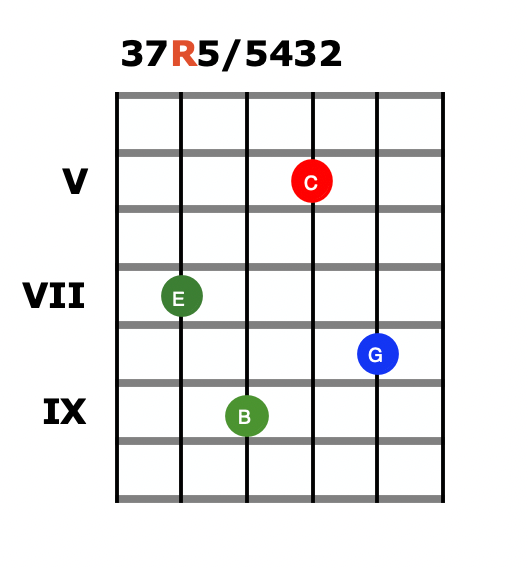
For example, a C major triad (C-E-G) in the open position has a distinct sound (and uses) compared to a C major triad in close position ( C-E-G ). The same applies to their inversions. In harmony, we give the same name to different voicing and inversions of the same set of notes e.g. C major triad, only for the sake of simplicity, and to address its harmonic function and tonal harmony classification, but each voicing is a distinct aural entity
Experimenting with different voicing can help you find the right sound for a particular song, invent melodic lines, countermelodies, and many other things, but the most important asset is that it will refine, improve and characterise your style as a guitarist.
You can and should explore different voicing for different inversions. In addition, worlds of possibilities open up when using different tuning – such as DAGDAD, different string-sets, open strings, tapping, etc…
Voiceleading
From a standard viewpoint, voiceleading is the art of connecting two chords, moving chord-tones as little as possible. This is a basic technique for creating smooth and flowing guitar arrangements.
By paying attention to the melodic movement of each note within a chord, you can create beautiful and seamless transitions, counterpoint lines, countermelodies and so forth.
When voiceleading, try to minimise the distance between the notes of one chord and the next chord. Often, to change from a chord to another, you need to move one or two notes only. Paying attention to the intervallic relationships between the notes help create smooth voiceleading as well.
Play your preferred chord progressions, and focus on the melodic lines within. Gradually work on transitioning between chords while maintaining a smooth melodic line. This will help you develop a strong sense of musicality and enhance your overall guitar playing.
Harmony
Harmony studies how to create and connect chords to balance tension and release. Understanding harmony is essential for creating interesting guitar parts. By knowing which chords to play and when to play them, you can create captivating guitar arrangements that complement the melody and overall musical context.
Start exploring new voicing and voiceleading using common progressions, such as the-IV-V or ii-V-I vi ii V. As you probably know, these progressions form the foundation of many songs in various genres. As you become acquainted, experiment with substitutions and extensions. Exploring chord functions, extensions, and chord substitutions will give you more tools to create interesting and complex guitar arrangements.
Conclusion
Integrating practical and systematic knowledge of voicing, voiceleading, and harmony into your playing will take your guitar skills to the next level. Last thing: be systematic in exploring, but let your ear be the judge behind rules and limitations; always listen to the music and let your musical instincts guide you. With time and practice, you will develop a sophisticated sense of musicality, like your best players.